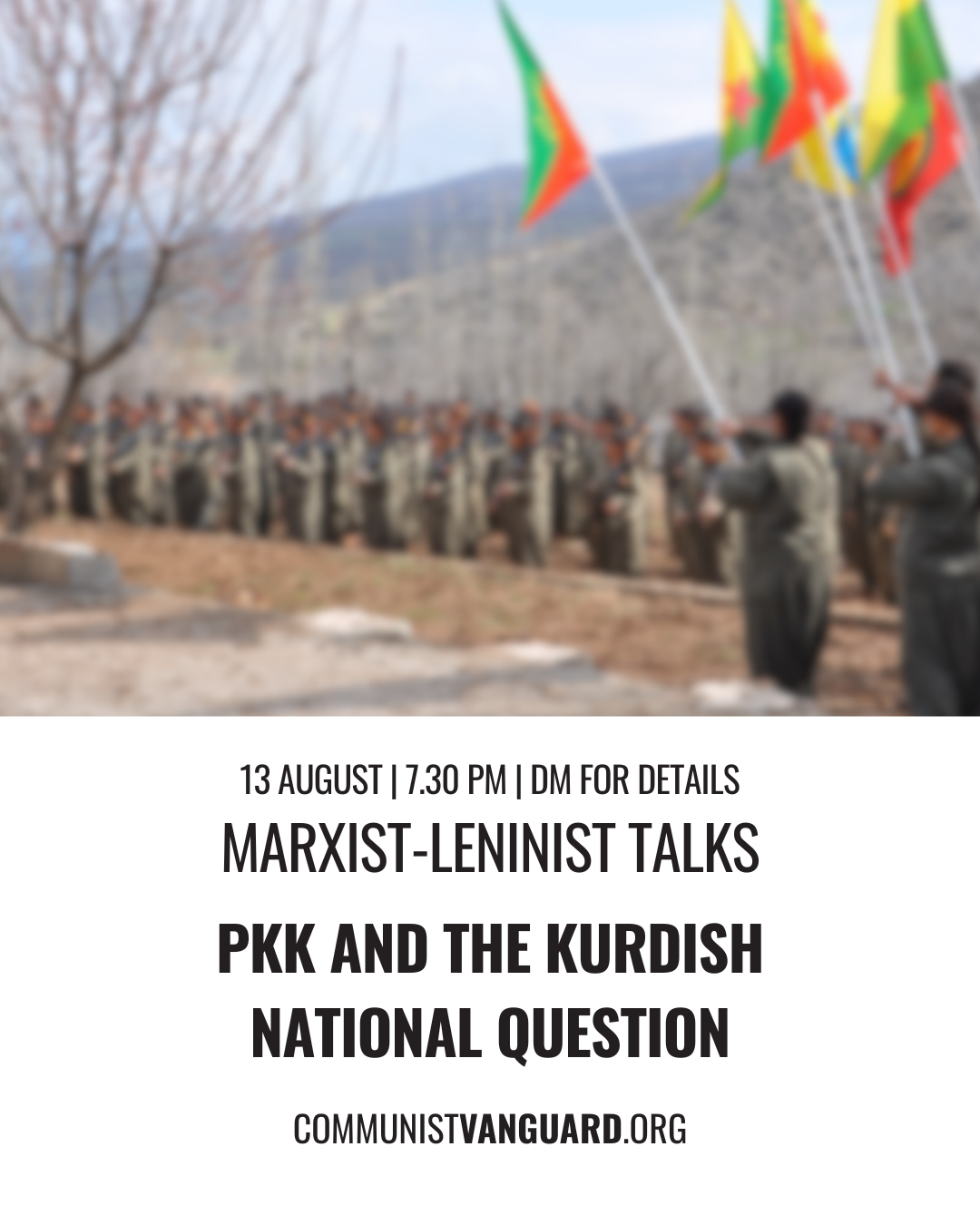
On the 13th of August, we will launch the first session of our Marxist-Leninist Talks, a series of events to discuss political developments in Britain and internationally. This time we will focus on the Kurdistan Workers’ Party (PKK) and the Kurdish National Question.
The PKK took its first concrete step toward disarmament in July 2025, symbolically burning weapons in a cave in northern Iraq, marking a clear end to its nearly four decade armed insurgency against Turkey. Yet this move was only the final chapter in a much longer ideological transformation: the PKK, originally founded as a Marxist Leninist organisation waging revolutionary war against Turkey, had already long since renounced a working-class point of view. Since the 1990s, under the framework of ‘democratic confederalism’, it progressively abandoned the goal of socialist revolution and fully reconciled with capitalist and imperialist structures.
From the standpoint of Marxism, the right of nations to self determination is a concrete, not abstract, principle. Lenin consistently defended this right, but he also warned against fetishising nationalism. Support for secession was never unconditional: communists support national movements only when such struggles objectively open the path to working class revolution. Conversely, when this aim is better served by the unity of workers across nations, or when national movements become instruments of capitalist or imperialist interests either locally or internationally, communists have the duty to expose the reactionary character of this struggle.
Join us for a presentation on the historical trajectory of the Kurdish movement, from early uprisings against colonial domination to the rise of the PKK as a Marxist Leninist force and its later transformation under the banner of ‘democratic confederalism’. Drawing on the Marxist theory of self determination developed by Lenin and Stalin, we will examine when national struggles can play a progressive role in weakening capitalism and imperialism, and when they instead serve as instruments of bourgeois rule, asking why sections of the left remain fixated on an uncritical support for the Kurdish movement.